

Fueling Women to Run the World: Our Founding Story
How a Customer Discovery Assignment Sparked a Mission to Revolutionize Sports Nutrition for Women
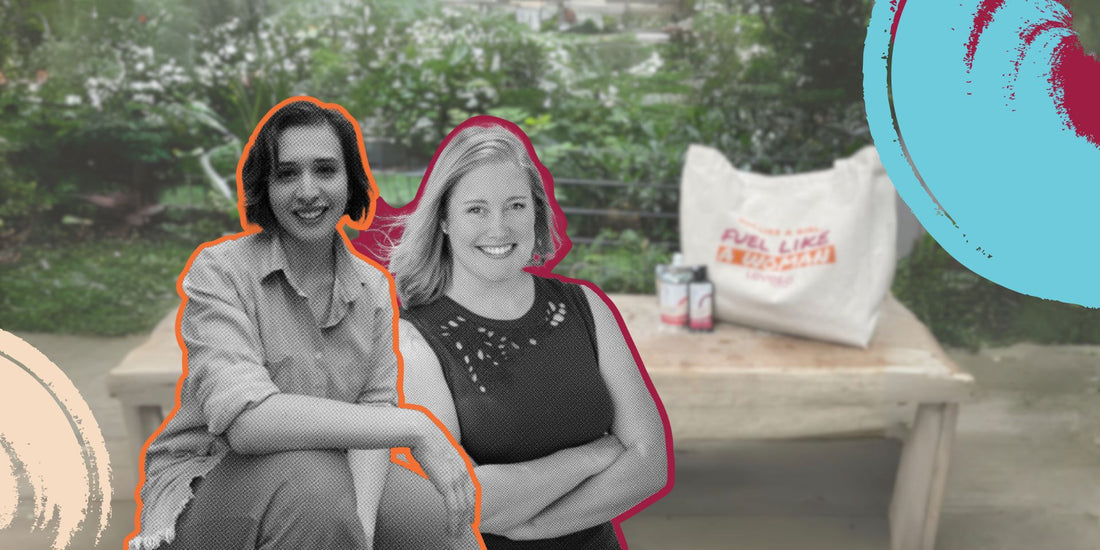
By Stephanie Schrauth, COO and Co-Founder of Levelle Nutrition
Invention is often described as the creation of something new. But the Latin root word, inventiō, actually means to find, discover, or come upon. For Levelle, this is particularly appropriate. We didn’t set out to start a company. We didn’t have an idea for a product. We barely knew each other. To be honest, we were just trying to get a good grade.
The second year of Cornell University’s executive MBA Metro program begins with a course in customer discovery, innovation and new venture creation. Somewhat counterintuitively, the professor adamantly and explicitly instructed student teams to not think about a product, but instead select a specific, identifiable customer group and just… ask them questions. And then ask them some more questions. And more, until we found a “hair-on-fire” problem. Identify a customer need and the product would follow, rather than the other way around.
Our team, to which the two of us were randomly assigned, picked non-sponsored marathon runners who held a full-time job and ran at least 2 half marathons a year. At first, we struggled. Sure, marathons were hard and required significant dedication and time, but those were features, not problems. Soreness was a badge of honor. We lucked out in the sense that marathoners love talking about running, and so we weren’t hurting for interviewees, but we couldn’t find a hair-on-fire problem.
Pants on Fire
It wasn’t until we met to discuss our findings with one of our advisors that everything clicked. Men, we noted, seemed nonchalant about their training and race day nutrition, while women couldn’t find fuel they loved. The most common complaint – too much sugar.
“What does that mean?” our advisor asked us.
Oh, of course. We actually had two different customer segments. We decided to focus solely on women, specifically around fueling.
Once we started asking more targeted questions, the floodgates opened:
“The goos turn my stomach and I can’t find something I can digest and have it settle nicely, but I can’t run on nothing. I’m still trying to figure it out. Multiple races I have thrown up, all based on nutrition.”
“I’ll take the goos and gels, but I hate the consistency. I only take it for the convenience and caffeine, and I have to back off before my stomach churns. The flavor and consistency need to match or it makes me gag.”
“I hate the gels. They’re loaded with sugar. They just sit in your stomach and the wheels come off halfway through the race.”
“Caffeinated gels are NOT good on a long run. You gotta poop tons.”
“I don’t use the gels, goos, caffeine, because my body isn’t used to it. Tons of synthetic weirdness.”
The takeaway? We hadn’t found a hair-on-fire problem. We had found a pants-on-fire one.
Asking Why
Why did nearly every woman we interviewed have a complaint? We started researching. What we found – or rather, what we didn’t – astonished and infuriated us.

Only 2.5% of products explicitly target women, and those that do cost on average 4.3% more per 100g but score 0.11 fewer stars in customer reviews.
Why the limited product selection?
Well, it’s likely linked to the fact that only 3% of injury prevention and performance studies and 33% of sports medicine studies include female participants.
Why aren’t women included in studies?
Because their monthly hormonal fluctuations “confound” results. In other words, women’s bodies change too often for consistency, so, like other variations that can’t be controlled, they are excluded.
Why is this a problem?
That’s a facetious question. Women are anatomically, biologically, physiologically and biochemically different from men. Specific to endurance fueling, women oxidize more fat and fewer carbohydrates than men. They therefore have different fueling requirements, especially around sugars. Women’s problems with sugar aren’t superficial, they’re scientific.
Why isn’t there a larger call for change?
That’s a good question. In the United States, women drive 70%-80% of purchasing decisions for their households. Additionally, they make up 45.7% of marathon runners, with their participation rates growing faster than men’s. Our assumption? Socialization and gender norms.
Women are encouraged to suffer silently. Talking about menstruation, menopause or other completely normal hormonal changes is still taboo. Our bodies are sexualized instead of celebrated. Of the women we interviewed, the majority thought the problem was with their own bodies, not with the products available.
From Course to Cause
Gradually, our academic assignment stopped being theoretical. Almost casually, we agreed we had found a real problem, we cared adamantly about solving it, and we worked well together. As women, as a physician and a product manager, we were affronted by the lack of appropriate offerings in the market. Women are not merely small men and they shouldn’t pay more for less.
We want to get women off the sidelines and into the spotlight. We want to account for women’s physiological differences, rather than pretending they don’t exist. We want to level the playing field, so you can run like a girl.
Now, we are embarking on our own marathon. It’s not going to be easy. It’s going to require significant dedication and time. We may stray off course. We may bonk three quarters of the way through. But, we are committed to reaching that finish line, and we are so excited to be moving forward.
We hope you run with us.
Love,
Dr. Linda & Stephanie
Co-founders, Levelle
